

I have neuropathy in my feet. They often tingle and feel numb. Over the years, I’ve had several knee surgeries, two shoulder surgeries, and trigger finger procedures. My doctor says I have poor connective tissues. Luckily, at age 60, I haven’t experienced much arthritis yet. I say yet because I do have a prescription for a muscle relaxer for my neck and back. Needless to say, as I’ve aged, my body sometimes aches, and it moves more slowly.
For nearly 35 of those 60 years, I have led the same Baptist church in Richmond, Virginia—Pine Street Baptist Church. It has been my only pastorate since I left seminary. I fell in love with the congregation and community when I first arrived, but I never imagined I would spend a lifetime here. My wife and I came as newlyweds, and we are now grandparents.
A lot can change in 35 years: the church, the community, and us. Even with stiff joints, I can still walk up the stairs to my office on the second floor of the church building. We have an elevator, but it’s mainly for the older folks and the kids who enjoy pressing the buttons. My office chair has molded to fit my body and tends to lean one way, just like I do. I do redecorate my office now and then, moving the pictures on the wall to give it a fresh look.
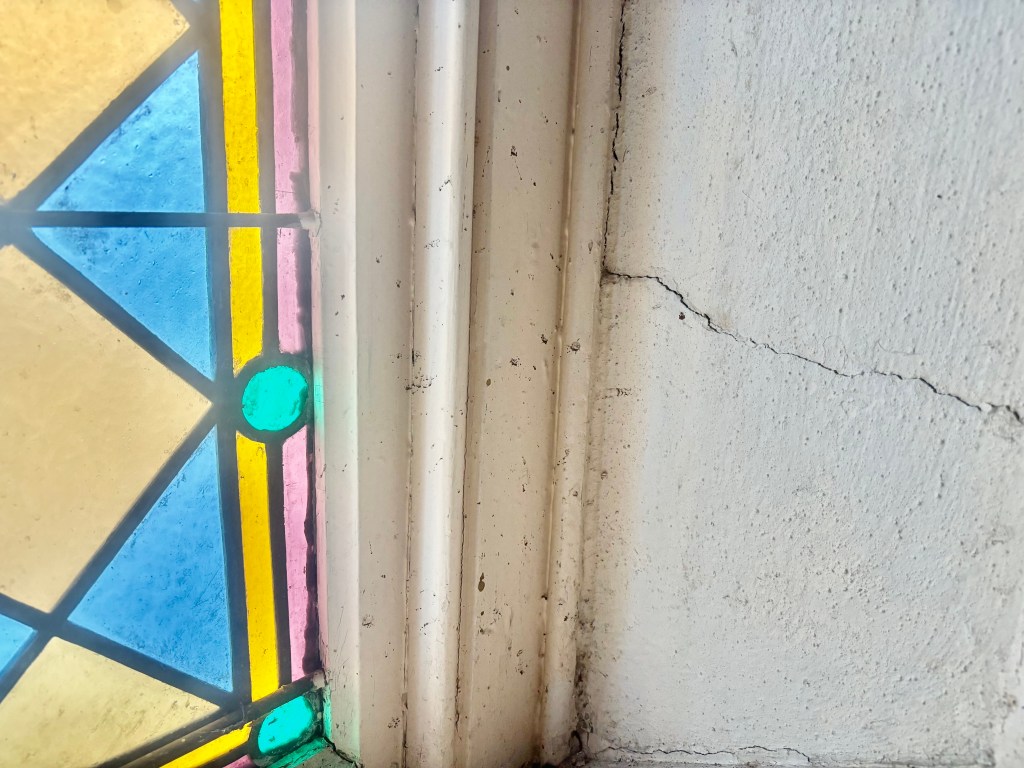
The church is old. 170 years. Being the pastor of Pine Street is to live daily with the weight of time. The building itself carries its history in its walls. Every brick seems to whisper the prayers and songs of those who came before us. But as the years press on, the building shows its age. The cracks in the plaster, the shifting of old stone, the strain on beams and foundations—they are small reminders that even sacred spaces bear the marks of wear.
I cannot look at those cracks without also seeing the ones in us. People carry fractures too. Relationships strain under disappointment. Words once spoken in love sometimes cut like glass. Families break apart, friends drift away, and even in the fellowship of faith, hearts can grow cold or distant. The church itself is not immune to brokenness—it is made of people, and people are fragile. One of the most challenging things has been seeing people leave our congregation. For different reasons, individuals have chosen to part ways with our church family. While a pastor tries not to take it personally, they do, and it always grieves them to see others leave.
For those who stay, they carry their brokenness with them. Each Sunday, as I look out upon the congregation, I think about the burden that I know many are personally bearing. Some are hidden behind the plaster of Sunday morning smiles and greetings, but beneath the surface, the hurts run deep, inflicted by a world that is often cruel with its pain. And then, there are the cracks in my own heart. They are harder to admit. I bring my own griefs into this place, my weariness, the pain I cannot always name. Some days I feel the heaviness of expectations, the loneliness that comes with leadership, and the ache of wounds that never fully close. Pastors are often thought of as healers, but we, too, are in need of healing.
Yet, here we are singing our praises to God in a sanctuary with cracks of its own, reminding us all that somehow God meets us there in it all.
Yet, I have found this: God’s grace flows most freely through the cracks. The places I wish I could hide are often the very places where God’s mercy meets me. What I thought would weaken me has softened me instead, teaching me compassion and reminding me I am not self-sufficient. The same is true for our church family. When we stop pretending we are whole, when we acknowledge our fractures, something holy happens. Grace slips in. Forgiveness has a chance. New beginnings take root.
The cracks in Pine Street’s walls are not just blemishes—they are symbols. They remind me that the church is not held together by perfect bricks or flawless beams, but by the living God who makes all things new. The cracks in our relationships remind me that love must be chosen again and again. And the cracks in my heart remind me that Christ is strong where I am weak.
Perhaps that is the strange gift of being pastor here: to walk among brokenness, my own included, and to discover that grace does not avoid the cracks but fills them. Slowly, tenderly, God mends us—not with plaster to hide our flaws, but with a love that makes the broken places shine with hope.
Even now, as we work on the real cracks in these walls—patching plaster, reinforcing beams, making sure this old sanctuary can stand—we must also allow God to do His work in us. Because if all we do is repair the building and never let Him repair our hearts, then we have missed the point. These walls may hold for another hundred years, but what matters most is what God is building within us.
As we tend to the visible cracks, let us not ignore the hidden ones: the cracks of bitterness, of weariness, of grief, of fear. Those require a different kind of mortar. They require grace. They require forgiveness. They require love stronger than any stone. God is not content to simply patch us up. He wants to dwell in us. He wants to fill the gaps with His Spirit until our very weakness becomes testimony.
 Conversations from the Couch
Leave a comment