An Active God

“His mercy is for those who fear him from generation to generation. He has shown strength with his arm; he has scattered the proud in the thoughts of their hearts. He has brought down the powerful from their thrones and lifted up the lowly; he has filled the hungry with good things and sent the rich away empty.” (Luke 1: 50-53)

As a parent, I can remember listening to my children play together in another part of the house. The sound of their voices let me know they were having fun and involved with some kind of activity.  I can also remember when the sound of them playing went silent for a length of time.  It was then that I began to wonder, “what are they up to?” The silence led me to question their activity.

Sometimes as Christians, we wonder what God is up to. We might feel as though God has grown silent and is no longer paying attention to our lives. This is especially true when we find ourselves facing a time of uncertainty.  Such times may leave us feeling anxious about the present moment. We might begin to doubt God’s presence.  If we don’t hear God, does this mean that God is taking a break from involvement in the world and our lives?

         As Mary continues to sing her praises to God, she confesses that God is a God of action who is always working to make his Kingdom a reality in the world.  With the strength of God’s arm, God is seeking to overturn the way the world works.  God is scattering the proud, bringing down the powerful from their thrones, lifting up the lowly, filling the hungry with good things, and sending the rich away empty.  God is active in bringing the Kingdom of Heaven here on earth. Mary recognized that the child in her womb would be God’s great change agent in the world. Jesus would visually demonstrate God’s power and presence. 

         In our lives, we can trust that God is indeed actively working to bring the Kingdom into our own lives.  God invites us to join him in this grand transformation that overturns the world as we know it.  As we seek to know God’s will in our lives, we can be confident that if we are living out the values of God’s Kingdom in the world, then we will be following God’s will. God will not ask us to participate in that which violates the values of the Kingdom of God.  For where God is King, God’s will is being done.

Prayer:  Lord, help me to live out your Kingdom in my life so as to bear witness of your work in the world.


Praise and Gratitude

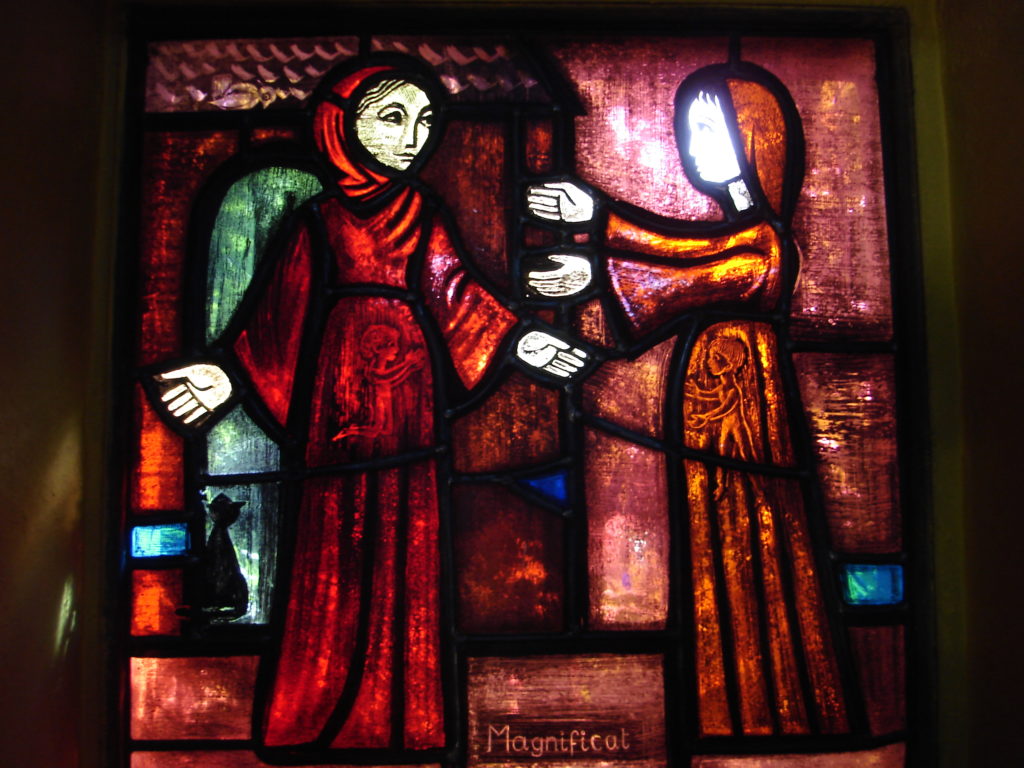
“And Mary said, ‘My soul magnifies the Lord, and my spirit rejoices in God my Savior, for he has looked with favor on the lowliness of his servant. Surely, from now on, all generations will call me blessed, for the Mighty One has done great things for me, and holy is his name.”          The Magnificat, also called Canticle of Mary, is the hymn of praise by Mary, the mother of Jesus, found in Luke 1:46–55.  It is named after the first word of its first line in Latin (“Magnificat anima mea Dominum,” or “My soul magnifies the Lord”).  At Mary’s encounter with Elizabeth and in response to her blessings, Mary sings praises to God for what God had done and is doing in her life.  Mary recognizes that God is worthy of her praise.  Mary is grateful for all that God is doing.

         Whenever we are seeking God’s will and direction for our life, as an individual or as the church, we should always begin with praise for what God has already done in our lives.  Our relationship with God tells the story of God’s faithfulness.  As we look back in our lives, we see how God has worked in our lives to bring us to where we are in the present.  There is no present without God’s guiding hand in our past.  Gratitude is our song to God.

         Thus, when we are looking to the future, as Mary was with this unexpected pregnancy, we can trust that the God of yesterday will be faithful in what is to come.  This gives us the hope to step forward in faith, knowing that we are not alone.  Every new day offers us the opportunity to experience God’s gracious work in our lives again.  Each new morning, we can sing the words of the old hymn’s lyrics, “Morning by morning new mercies I see.”  Great is God’s faithfulness.  This is something to sing about.

Prayer:  Thank you, God, for your faithfulness.  I am grateful for all you have done in my past and promise to do in my future.

Affirmation

“In those days, Mary set out and went with haste to a Judean town in the hill country, where she entered the house of Zechariah and greeted Elizabeth. When Elizabeth heard Mary’s greeting, the child leapt in her womb. And Elizabeth was filled with the Holy Spirit and exclaimed with a loud cry, ‘Blessed are you among women, and blessed is the fruit of your womb. And why has this happened to me, that the mother of my Lord comes to me? For as soon as I heard the sound of your greeting, the child in my womb leapt for joy. And blessed is she who believed that there would be a fulfillment of what was spoken to her by the Lord.” (Luke 1: 39-45)

         Discernment does not occur in isolation, even in our personal discernment journeys.  Rather, as we seek to know God’s will, we often turn to the people around us for affirmation and support.  When we feel as though God is speaking to us, we look to family and friends for encouragement.

Soon after Mary’s encounter with Gabriel about God’s working in her life, Mary travels with “haste” to see her cousin Elizabeth who is pregnant even in her old age. Elizabeth and her husband, Zechariah, will eventually become the parents of John the Baptist, the forerunner to Jesus. 

Elizabeth offers to Mary just what she came looking for, affirmation and support. Upon seeing Mary, the baby in Elizabeth’s womb leaps for joy leading Elizabeth to confess, “Blessed are you among women, and blessed is the fruit of your womb.” Elizabeth recognizes that indeed God was doing something miraculous in Mary’s life.  

         When we are seeking discernment in our lives about God’s will, it is a good practice to talk to others about what we are considering.  God often uses individuals in our lives to help us out along the way.  We should seek out other people’s thoughts as we wrestle with our own.  Indeed, God has a way of putting certain people in our lives to do this very thing.  I’m sure this was not the only time Mary turned to Elizabeth.  Family and friends are always a part of the discernment journey.

Prayer:  Thank your Lord for the individuals in my life that offer me love, support, and encouragement.

Here I Am

“Then Mary said, ‘Here am I, the servant of the Lord; let it be with me according to your word.’ Then the angel departed from her.” (Luke 1:38)

         I can remember in school that each day the teacher would take attendance.  It usually involved the teacher calling out the names of the students on their roll and the students responding, “here” or “present.”  Your response let the teacher know you were where you were supposed be as a new school day began.  

         After Mary hears the angel messenger speak for God, she responds, “Here I am.”  Even with all her doubts and fears, Mary would be present to Gods’ plan for her life.  She would not try to skip out on God’s agenda, but she would step out in faith and begin this incredible journey.  Hence Mary not only says, “here I am,” but she also states, “let it be with me according to your word.”  Mary would make herself available to be used by God in God’s plan to save the world.  Her life would now be led and shaped by God’s word.

         Trying to figure out God’s will for our lives means making ourselves present to God and willing to follow God’s word in our lives.  As individuals and as the church, we begin our journey with God by simply confessing, “here.”  We show up; we become present to God.  Then we surrender our wills over to God and commit to living out God’s will.  This is not an easy step to make.  There can be a lot of inner struggling between saying “here” and “let it be.”  However, like Mary, we can trust that the God we become present to will always be present with us.  God’s presence gives us the courage to surrender to God’s will and to trust God for the journey ahead.

Prayer:  Here I am, Lord. Send me.

Impossible

For nothing will be impossible with God. (Luke 1:37)

It can’t be done.  How often have we heard these four words in our lives in relation to a lot of our experiences?  It can’t be done settles the matter about something we perhaps hoped for.  Whatever our hope or dream was, it was not going to happen.  It would be impossible.

It seemed impossible for Mary that she could conceive a child at this point in her life.  Yet, the angel revealed that God’s Holy Spirit would be involved.  And when God gets involved in any situation, nothing is impossible.  

Impossible.  This word inserts itself in our stories at different points along life’s journey.  We face a situation that simply cannot be overcome. We realize that we have run out of options and that there is no hope for any change in the outcome.

Pastor and theologian John Piper states, “Darkness comes. In the middle of it, the future looks blank. The temptation to quit is huge. Don’t. You are in good company… You will argue with yourself that there is no way forward. But with God, nothing is impossible. He has more ropes and ladders and tunnels out of pits than you can conceive. Wait. Pray without ceasing. Hope.”

God would bring about the impossible in Mary’s life.  Mary would become the mother to Jesus.  In our lives, God can birth forth new possibilities when we feel as though we have no hope.  When our horizons are limited, we must remember that God’s viewpoint is much different.  Discernment is about trusting in God’s viewpoint.  God sees what we cannot see.  Faith is trusting in God’s vision.  In Hebrews 11:1, we read, “Now faith is the assurance of things hoped for, the evidence of things not seen.” Sometimes we look at the evidence and say no way.  Faith, however, reminds us that with God, all things are possible.

Prayer: Help me to trust in your vision for my life and to hope even when everything around me says “impossible.”

The Work of the Spirit

The angel said to her, “The Holy Spirit will come upon you, and the power of the Most High will overshadow you; therefore, the child to be born will be holy; he will be called Son of God.” (Luke 1:35)

Mary faced a seemingly impossible scenario: giving birth while still a virgin.  She had already asked the angel how this could be?  It didn’t make sense, and she was dumbfounded at the thought of giving birth without sexual relations. 

The angel addresses Mary’s doubt by revealing to her that God’s Holy Spirit will bring it about in her life.  The power of the Most High will overshadow Mary.  To overshadow means to cast a shadow, much like a cloud does with the sun.  In the Old Testament especially, a cloud often symbolized the immediate presence and power of God.  We think of the cloud that overshadowed Mount Sinai, where Moses encountered God and received the Ten Commandments.  

God’s power and presence would create new life in Mary’s virgin womb.  The holy child, the Son of God, would be born because of God’s Spirit working in the life of Mary.

As we seek to discern God’s will for our lives, God’s power and presence overshadow us as well.  Discernment must be Spirit-led.  When we seek to live our lives apart from God’s presence and power, then we are destined to fail.  Wherever humanity has sought to live outside of God’s shadow, humanity has fallen away from God’s will and God’s purposes.  When we turn from God and into ourselves, then we will ultimately end up discouraged, frustrated, and fatigued.  Outside of God’s presence, our lives remain barren to the possibilities of God.

Prayer:  Help me to trust in your Holy Spirit to lead, guide, and direct my life.

How Can This Be?

“Mary said to the angel, ‘How can this be since I am a virgin?’” (Luke 1:34)

         Life is full of questions about things that we do not understand.  Whether it is a student in school wrestling with Algebra, a stranded motorist looking under their car on the side of the road, a worried father looking over the family finances, or a grieving individual trying to come to terms with someone’s unexpected death, we spend a lot of life asking questions.  Who, what, where, when, and how are often the first word in many of our thoughts and statements.

         When Mary was told by Gabriel that she was to conceive a child in her womb, her first response was, “how can this be, since I am a virgin?”  Mary might not have known anything about algebra, but she knew basic biology.  Virgins don’t have babies.  She and Joseph had not yet sexually been together, so conception seemed impossible.  The math just did not add up.  She is left only with a question, “How can this be?”

         The process of discernment itself is filled with questions.  When you are trying to discern God’s will for your life or for your church, it might seem like you have more questions than answers about the future.  Questions that sometimes seem impossible to answer.  However, discernment by nature begins with questions. As we wrestle with God’s will for our future, there are many unknowns that must be addressed.  Answers to these unknowns do not necessarily come easy or quickly.  Discernment takes time.  Although you will have to ultimately come to some decision, rushing toward an answer can be disastrous.  Just as Mary’s pregnancy would take nine months to be fulfilled, and there would be many questions along the way, so is it in our own lives.  Discerning God’s will means sometimes waiting on the answers to be born.

Prayer:  Give us, Lord, the courage to ask the right questions and the patience for you to answer.

Conceived

And now, you will conceive in your womb and bear a son, and you will name him Jesus. (Luke 1:31)

How many times have you heard someone in church say from the pulpit, “Let’s stand and sing,” and then offer a hymn number for you to join the singing?  It is an invitation to participate in the worship of God.  Although we might not be the best singers, we join voices with others to offer our praise.  We are now part of worship.

Mary would have a big part in God’s story of salvation.  The angel Gabriel tells her that she will conceive in her womb, bear a son, and name him Jesus.  The miraculous birth of Jesus would require Mary’s womb, her physical and emotional energy, and her entire life.  Mary would not be a bystander, but she would participate in God’s great work. 

When we are seeking God’s will for our individual lives or our life as a church, God invites us to participate in the process.  While seeking God’s will does require trusting in God, it also means actively seeking God’s direction through prayer, reflection, meditation, scripture, and conversation with others.  God desires to conceive in us His will rather than force us into a plan which we have no say.  God invites us into a dialogue with Himself so that we might understand what it means to be his vessel in the world. 

When we participate in God’s will, then miracles happen.  In Ephesians 3:20, the Apostle Paul writes, “Now to Him who is able to do so much more than all we ask or imagine, according to His power that is at work within us.” God can do wonders in and through us, and he invites us to join Him in the birth of something new.

Prayer:  Lord, help us to discern your will by actively seeking your direction for our lives in prayer, scripture, reflection, and conversation.

Do Not Be Afraid

December 3

Luke 1:30

The angel said to her, ‘Do not be afraid, Mary, for you have found favor with God.

         I have always liked scary movies.  There is something about watching individuals face something they are afraid of.  It might be a monster, ghost, or some other entity that leaves them fighting for survival.  Scary movies have a lot in common, like dark rooms, screams, running from something or someone, and dire situations.  While watching such movies, I wonder how they are going to get out of the situation, for fear can cause you to react in a variety of ways.  What do we do when we are fearful?

         There is a lot of fear in the Bible.  In fact, the phrase “do not be afraid” or some form of it is used quite often by God when addressing humanity.  Whether it was Moses and the people of Israel standing before the Red Sea with Pharoah’s army chasing them down or Mary standing before the angel Gabriel, fear rises in the hearts of God’s people often.  Hence, God is often speaking words of assurance to them.  

         God knows that our world can be a scary place.  Life can turn dark in the blink of an eye and leave us shivering in fear of the darkness.  No person is immune from such experiences.  People with faith in God and people who don’t even believe in God encounter dark times.  It is a given in a broken and sinful world. Fear happens.

         Gabriel must have seen it in Mary’s eyes as he immediately tells her not to be afraid and reminds us again that she is favored.  Gabriel sought to reassure her that even though the future seemed scary, she did not need to fear this future.  She need not fear because she could step into that future believing that God was still in control.  

         We, too, step into uncertain futures.  Fearful experiences can be just over the horizon, unbeknown to us.  We never know what tomorrow might bring.  But we do know who holds our tomorrows.  Regardless of life’s fearful times, God is still upon God’s throne.  The prophet Jeremiah would remind an exiled and fearful people of this truth when he said, “For I know the plans I have for you says the Lord.  Plans for your welfare and for harm.  To give you a future and a hope.”  (Jeremiah 29:11) Mary would have a future and hope.  So do we.  Yes, there will be fearful times, and we will be afraid.  Yet through it all, God continues to remind us, “Do not be afraid.”

Prayer:  Lord, life can be scary.  Help me trust in you when I am afraid and to live not in fear but in faith as Mary did.

Perplexed

Luke 1:29

But she was much perplexed by his words and pondered what sort of greeting this might be.

Sometimes life leaves our heads spinning and stomachs turning.  Some experience or event has caught us off guard, and we are left “shell shocked.”  We don’t know if we are coming or going. Such times can seem overwhelming to us as we ponder how we can go forward.

         After Gabriel’s promise of God’s grace and presence, Mary is perplexed by his greeting.  What did it all mean?  The word perplexed in the original language means to “agitate.”  Now when I think of something agitating, I immediately think of a washing machine.  Once the clothes are loaded and the tank is filled with water, then the machine begins to agitate.  The agitator inside turns the water and the clothes while pulling the clothing down deeper into the water.  This goes on for some time until the cycle shifts, the agitation stops, and water the drains.

         I imagine Mary felt like an article of clothing in a washing machine. She is perplexed as life has suddenly begun to agitate in the most unexpected way.  Luke tells us she begins to ponder what kind of greeting she has just received.  What will it mean for her life going forward?  So many questions were now swirling around inside of her.

         We, too, sometimes find ourselves in situations where we feel as though we are tossing and turning and neck-deep in water.  How often have we agitated all night while trying to sleep because something weighed heavy on our hearts and minds?  Sleepless nights can show up anytime as we wrestle with what to do next in our lives.

         Discerning God’s will for our lives is not always clear-cut.  More often than not, we will have to do some agitating.  Biblically we might call it wrestling with God like Jacob did that night in the wilderness in the book of Genesis.  Discernment may lead us to question a lot of things, even God.  We may be entangled in doubt and fear as we seek to make sense out of our lives.  Yet, we do not need to feel guilty.  Discerning God’s will can be complicated.  The good news is that God doesn’t mind that we wrestle with him.  In fact, wrestling with God often leads to an even stronger faith. 

         Mary would need strong faith as she moved forward in God’s plan to redeem the world through her. God has a plan for our lives as well, and it takes faith to learn what that plan is.  Like Mary, we can trust that God has thought things through, even as we begin to discern what God is asking.

Prayer:  Lord, show us the way even as we find ourselves perplexed in what you are doing.

The Lord is With You

In the sixth month, the angel Gabriel was sent by God to a town in Galilee called Nazareth, to a virgin engaged to a man whose name was Joseph, of the house of David. The virgin’s name was Mary. And he came to her and said, ‘Greetings, favored one! The Lord is with you. (Luke 1: 26-28)

When the angel Gabriel appeared to Mary for the first time, it must have been an overwhelming experience.  When a divine messenger shows up on your doorstep, how do you respond?  I can imagine that Mary was stunned by such an angelic visit.  Did she look like the proverbial “deer in the headlights” as God’s messenger greeted her? Where do you even begin with such an experience?

         According to Luke, after Gabriel appears to Mary, his first words to her are, “Greetings, favored one! (notice the exclamation point) The Lord is with you.”  After the hello, Gabriel presents to Mary two profound truths:  Favored one and the Lord is with you.  Mary is addressed as a “favored one.”  The Greek word used literally means to endow with grace.  Gabriel’s first word is a blessing.  Mary is a recipient of God’s grace.  Grace would be the theme of Mary’s story.  God had chosen her and, out of God’s love, blessed her.  God’s grace is a gift.  It cannot be earned by anything we do.  God freely offers it to us.  The only other use of the word “favored” is found in Paul’s letter to the Ephesians where he writes, “To the praise of his glorious grace that he freely bestowed on us in the Beloved.” (Ephesians 1:6) Each of us, like Mary, are living lives that have been offered God’s grace.  God knows that we cannot make it on our own.  Whether we are facing a crisis or the need for a decision to be made about our lives, God’s grace is available to us.  Whenever we seek to discern God’s will for our lives, we begin with God’s grace.  If we begin with God, then we can trust that God will show us the way.

         Not only is Mary favored by God, but Gabriel promises to her that God is with her. Mary would not journey alone as she went forward after this encounter.  God would be present with her from that moment on.  Likewise, in our lives, we can trust that God goes with us.  The meaning of the name given to Jesus of Immanuel tells us just this: “God with us.”  We do not live our lives apart from God’s presence.  We are never separated from God’s love.  Regardless of where we are on life’s journey, God will be present with us.  The infant Jesus would only lie in a manger for a brief time.  But for everyone who trusts in God’s promise, our hearts and our lives become his permanent dwelling.  Jesus makes his home in us.

         Mary still had a lot of questions for her angelic visitor, as the story will show. God’s grace would show her the way through all her doubts and fears.  We, too, can be led by God’s grace as we place our faith in Jesus.  God’s grace will always show us the way.

Prayer:  Thank you, God, for entering our lives and offering us your grace.  Your favor rests upon us, and we are truly blessed.  Amen

Taste and See

Perhaps one of the strangest symptoms of the COVID 19 virus has been the loss of taste. Some people who have contracted the virus lose their ability to taste. Indeed, it would be a strange sensation to put something in your mouth, and your taste buds do not respond to what is there. Eating and drinking would lose all their pleasure. Taste is important to us.

In Psalm 34, the psalmist writes, “taste and see that the Lord is good.” (Psalm 34:8) The psalmist invites us to taste, that is, experience God as part of our lives. It is an invitation to join our lives with God’s presence. A presence, a taste, that is good. God desires to share in his goodness. God invites us to experience a life that is full, complete, and satisfying, the good life.

Yet, it is always up to us to choose to taste that which is offered to us by God. God will not force-feed us when it comes to a relationship with God. We can accept and receive or reject and turn away from God’s invitation. In Jesus, we experience God’s goodness and life. In Jesus, we can taste the very nature of God. To know Jesus is to know God. To taste the life that Jesus offers is to experience God. In the Gospels, Jesus often compared himself to bread and water and invited people to partake of the water and the bread of life, which would satisfy our thirsts and our hunger.

In our world, as in the day of Jesus, there are many things that invite us to taste and experience them with a promise of satisfaction and fulfillment. We are offered a daily taste menu of things that promise to provide us with the life we long for, a life of wealth, pleasures, fame, power, and the like. And while they may taste wonderful to us, we soon discover that they never seem to satisfy, so we begin long for something else. This is one of the themes in the parable of the prodigal son. The wayward son traveled to a distant country to taste the good life, only to lose everything. He ended up hungering for the same slop that he now fed pigs to for a living. He now lived with a bad taste in his mouth. Yet, as the story unfolds, realizing what he had thrown away when he left his father’s house, he decides to return to perhaps find a job as one of his father’s servants. Yet, when his father sees him coming home, he greets his lost son with hugs and kisses and throws a party complete with the best food and drink of his father. The prodigal son is invited once again to taste and see the father’s goodness.

We, too, are invited to taste and see God’s goodness. However, our tasting of God is not an end. We are now called to live our lives in such a way that creates God’s good taste for those around us. When people experience us, do they taste God’s goodness? In Jesus’ Sermon on the Mount in Matthew, he states, “You are the salt of the earth. But if the salt loses its saltiness, how can it be made salty again? It is no longer good for anything, except to be thrown out and trampled underfoot.” (Matthew 5:13) As followers of Jesus, we are called to make the world taste better by living Jesus’s kind of life. We are called to create the kind of taste the apostle Paul wrote about in his letter to the church at Galatia: “The fruit of the Spirit is love, joy, peace, forbearance, kindness, goodness, faithfulness, gentleness and self-control.” (Galatians 5: 22-23) We are invited to live tasty lives.

So, “taste and see that the Lord is good.” And having tasted, then go and live a life that creates the flavor of Jesus Christ so that all might experience the goodness of God.

The Gift of Forgiveness

Trying to find a Christmas gift for someone can be challenging at times. Some people are just hard to shop for. Choosing something to give them as a gift does not come easy for various reasons. We search for what we think will be a fitting present, but even the gift we finally decide on still leaves us with uncertainty. Do they need it, will they like it, is it their style are questions we try to answer? 

During the Christmas season, when a high emphasis is placed on family and friends, fun and fellowship, and togetherness, one can often observe a tremendous amount of stress and tension regarding the people in our lives. Wherever there are relationships, you can be sure that there are also hurt feelings, misunderstandings, animosity, and bitterness. Relationships are fragile things that can easily be broken over time in our lives. People stop talking to one another, ignore one another, and speak badly about someone to others. It happens in our families, friendship circles, workplaces, and even in our churches. Hence, singing “sleep in heavenly peace” is sometimes hard to find when there is no peace with the people in our lives when the Christmas season arrives.

In the Gospel of Matthew, Jesus states in the Sermon on the Mount, So when you are offering your gift at the altar, if you remember that your brother or sister has something against you, leave your gift there before the altar and go; first be reconciled to your brother or sister, and then come and offer your gift.” Jesus instructed his followers that in bringing their gifts of offering to God in worship, remember that there is a broken relationship in their lives. They should first seek to reconcile this relationship by offering and receiving forgiveness. Forgiveness is God’s way of healing relationships that become broken in our lives.  Indeed, forgiveness is the gift God offered to all of humanity because of our sin.

This Christmas, we might want to think about offering the gift of forgiveness to others in our lives and receive forgiveness when offered to us. We don’t have to begin a new year weighed down by the broken relationships in our lives.  Instead, we can realize that life is too short to continue to cling to the unforgiveness in our lives.  We can let of bitterness and animosity and replace them with the gift of forgiveness.  And when forgiveness is offered and received, only then can we genuinely sleep and live in heavenly peace. Thus, perhaps before the big gift exchange of Christmas day, we might first seek to reconcile with people in our lives so that the joy of the gift-giving season finds its real meaning. 

Picture Perfect

The perfect life. What does it look like? Every individual imagines what life would be like for them if it were perfect. Maybe they would have plenty of wealth so that questions about how to pay for anything were irrelevant. Perhaps a life without illness, not even a runny nose. The perfect life could be one where every street is easy, and obstacles and detours are not part of getting around in the world—a world without anxieties, fears, or worries. Maybe the perfect life would be one of complete happiness where sadness has no home. 

However, it doesn’t take long to live in our world to realize that no such life exists. Whereas we may have security and ease in one part of our lives, other aspects of our lives can be in complete disarray. We might not have to worry about our finances, but our health is in dire jeopardy. We might have the perfect job, but our family life is a wreck. Perfection in our world is a hard commodity to come by.

C. S. Lewis, in his classic work, The Four Loves, writes, “Don’t let your happiness depend on something you may lose.” Yet, this is just where we so often seek out our happiness and our perfect life, in that which does not last forever. In life, we constantly must come to terms with our losses. People whom we love die and leave this world. Our health falters along the way. Possessions we purchase with glee and cheer soon lose their luster. Relationships become broken. People disappoint us just as we disappoint others. The picture-perfect world we hope for cannot be found in our world. And when we do think we have found it, it is only a matter of time before our picture-perfect world is broken again.

I like to think that when God created the world that indeed everything was perfect. Our relationships with God, with one another, and with all of creation were one of peace and harmony. God’s good world was offered to all as the best gift of all. Yet, we spurned the gift and the giver in time as we sought to find perfect happiness in something or someone other than God. Sin entered the picture, distorted the image, cracked the glass, and broke the frame. Our picture-perfect world was now anything but perfect.

Life is now about living in an imperfect world but trusting in a perfect God. When we anchor our ultimate happiness in God, we discover the life we have always longed for. Not the perfect life, but a life that knows that regardless of the brokenness of life, the losses we face, and even the pain we endure, God’s perfect love, grace, and presence will not falter. We can trust in God’s goodness. As we read in Isaiah 54:10 – “Though the mountains be shaken and the hills be removed, yet my unfailing love for you will not be shaken nor my covenant of peace be removed,” says the LORD, who has compassion on you.” While our lives may seem fragmented and broken at times, God is perfect in all God’s ways. We can trust in God in an imperfect world. We can trust that God is working to restore his broken creation to its perfect state. We hope that God will ultimately bring us the promise of the book of Revelation. “I heard a loud voice from the throne saying, “Look! God’s dwelling place is now among the people, and he will dwell with them. They will be his people, and God himself will be with them and be their God. He will wipe every tear from their eyes. There will be no more death’ or mourning or crying or pain, for the old order of things has passed away.”(Revelation 21: 3-4)

Until this day arrives, however, as a people of faith, we must do our part to bring a perfect heaven into an imperfect world. We pray as Jesus taught us to pray, “Your Kingdom come, your will be done, on earth as it is in heaven.” God is seeking to make all things new. We must join with God in this great calling to move us closer and closer to a picture-perfect world.  And when get there by following the ways of Jesus, of living in love, grace, mercy, kindness, generosity, patience, and the other riches of a life abiding in God.  Jesus is the perfect picture of the kind of people we are called to be in our world.

Running Low on Patience

Not everyone has had the experience of their vehicle running out of gas. We may have driven on “Empty”, but we made it to the nearest gas station to refill the tank. Some of us, however, know the feeling of your vehicle starting to putter as every drop is used up by the engine. Without the gas, you are done traveling for now. Wherever the gas tank went completely empty, that’s where you are. All you can do now is wait to find gas somehow, whether it is you walking down the road to look for a station or a kind passerby stops and helps you out. Regardless, you will have to do some waiting.

In our society, we do not often tend to do well when it comes to waiting. In our fast paced, instantaneous culture, we are not accustomed to waiting too long for anything. If the wait becomes too long, we start to run out of patience. We may be impatient with our current situation, or we may lose patience with another person. And as we have seen, when patience runs out for an individual that individual can sometimes act out in some not so positive ways. We lose our tempers and tend to “show ourselves.”

As followers of Jesus, we are called to live lives that demonstrate patience. Patience in trying situations and patience with other people. Paul, the Apostle, in his letter to the church in Corinth wrote about God’s love, “Love is patient and kind.” (1 Corinthians 13:4) Christian love models itself after God’s love with overflows with patience towards each of us. In 2 Peter 3:9 we read, “The Lord is not slow in keeping his promise, as some understand slowness. He is patient with you.” God knows that we are all works in progress. Our Christian journey is about growing more and more like Jesus. It is a progressive growth that takes time and dedication. Along the way, we stumble in sin, walk away from God’s desires, and find ourselves stuck and not making any progress. If God were not patient with us, we would be in some serious trouble. Yet, because God is loving, God is willing to wait and work with us. God is patient with us because God knows that time makes a big difference.

Patience is indeed a virtue in our lives. It doesn’t always come easy for us, but it should be a daily goal to live with the kind of love that demonstrates God’s kind of patience. Patience which is loving and affirming, encouraging, and forgiving, gentle and kind. In a world that seems to lack patience, Christians must model the better way of Jesus by living and relating to others as Jesus did. Jesus always saw individuals as worthy of his time, his attentiveness, and kindness. And he did it all out of his love for God and his love for others.

When we say yes to Jesus, we say yes to all of Jesus; even those aspects of Jesus’ life that we find challenging, like living with patience, and being patient with others. When we demonstrate patience in our lives it will cause others to take note because this is not the way the world operates. Hence, our patience with others can be a powerful witness to our God who is patient with all of us. Sometimes we can find ourselves running low on patience. It is then we need to stop and be refilled with the One who is patient with us. 

Photo by ROCKETMANN TEAM on Pexels.com

Salty Talk

I am one of those individuals who salt everything I eat, often before I have even tasted it. For me, salt just makes everything taste better. Seasoned food is something most people appreciate. For those who must eat a bland diet, the food is just not the same. Seasoned food makes a big difference.

In his letter to the Colossians, the apostle Paul encourages these new Christians to season their speech with salt. Paul invites his readers to let their speech be gracious. The dictionary defines gracious as, “courteous, kind, and pleasant.” (Colossians 4:6) Paul realized that words mattered and that our choice of words and the tone of our words can build others up as well as tear others down. Hence, Paul challenges Christians to speak with grace.

We need grace seasoned words in our society today. So much of our speech has become toxic, poisoning the streams of our conversations. Whether discussing politics, religion, issues of the day, and the like, we often choose words that lack grace. Rather, we opt to use words that divisive, negative, and destructive. Wars of words seem to break out daily in our families, businesses, schools, governing bodies, and even in our churches. In fact, it is perhaps most disturbing in the body of Christ because it stands in stark contrast to the way of Jesus and the way he calls his followers to live. A lot of what we say as Christians is lacking in grace.

However, words seasoned with grace tend to encourage, support, build up, and offer love to those who they are spoken to. Such words can be a healing force in a world where relationships are broken in so many ways. Words that are gracious will be forgiving and will seek to speak reconciliation among people. Such words seek to build bridges and not walls and will seek to unite rather than divide. Our words have power so we must use them wisely. 

Unfortunately, in our modern society, social media has allowed us to speak in ways that we might not ever speak in open, face to face conversation. By not having to look at others in the eyes we tend to become much more careless and callous in the words we use. Or we often post someone else’s words with little thought of what the person said. We look for words that “pack a punch” rather than extend a hand. And as far as I can tell, we as Christians tend to speak much like others who claim no relationship to Jesus. It is easy to lose our way in this war of words.

We must seek, however, to allow our words to be shaped by the way of Jesus. What we speak should bear witness to the one we claim has seasoned our lives with grace. Otherwise, our words sound and taste like the rest of the world. Seasoned in grace, however, our words can be healing force in the world’s daily conversations.  

Salt shaker with large and small salt on a black background ** Note: Visible grain at 100%, best at smaller sizes

Is There Any Good News?

How often do we ask these days, “Has anyone seen my phone?” Oh, how we tend to misplace them in our homes. We go to reach for it, and it is not where we thought we left it. After a moment or two, panic can set in as we don’t know how to go about life without it right beside us. Usually, after a search, it is found. It may be found nn the couch cushion, on a counter, in the bathroom, and the list of possible locations is endless. But it all begins with a question. “Has anyone seen my phone?”

It just seems like more than not; I find myself asking another question regularly: “Has anyone seen or heard any good news?” Every day it seems that we are met with a tsunami of bad news in our world. Our local and world headlines read like a litany of bad news filled with tragic events, human suffering, sorrow and sadness, and lost hope. When you add to that your struggles, bad news events, and times of uncertainty, it leaves you wondering if there is any good news out there? You may feel like you can’t take any more bad news.

In the book of Proverbs, the writer states in Proverbs 15:30, “The light of the eyes rejoices the heart, and good news refreshes the body.”  Good news refreshes the body.  According to the writer of this scripture, good news can refresh our lives by renewing our hope and faith in God’s goodwill for the world.  God is a God of good news.  This good news is most clearly seen in God sending his only son, Jesus, into the world.  When Jesus stepped onto the human scene, he brought God’s good news with him and in him.  The Gospel of Mark begins its story of Jesus this way: “The beginning of the good news of Jesus Christ, the Son of God.”(Mark 1:1) And when Jesus began his active ministry, he proclaimed, “The time is fulfilled, and the kingdom of God has come near; repent and believe in the good news.” (Mark 1:14) Jesus was all about good news.  Good news which can transform individual lives and ultimately the entire world.  In a world filled with bad news, God stepped in and changed the world’s narrative.

Is there any good news out there?  Yes, there is.  The good news is anchored in the person of Jesus Christ, God’s response to the bad news headlines.  In Jesus, God infuses good news back into the world and into our lives.  We can now share in that good news in such a way that our lives are transformed and made new.  This good news refreshes, revives, rekindles, reshapes, renews, and remakes us.  Bad news will not be the final headline. Jesus is and always will be the story of the day.

Once we receive this good news and begin to follow Jesus, we must now live our lives in this new reality.  We are now called to be the “good news” in other people’s lives.  Our lives should be living reflections of the good news of Christ Jesus.  Our words and deeds should be reminders for all people to see that God’s good news is greater than any bad news they might find themselves in.  God can use us as instruments of his good news to bring hope into other people’s stories.  We cannot hoard the good news that God has shared with us, but we must live it out in our lives so that all people might read the headline of every day: “The time is fulfilled, and the kingdom of God has come near; repent and believe in the good news.”  So, is there any good news?  Hopefully, the answer is yes as we become good news in Jesus Christ for all the world to see.

His Strength is Perfect

We are bombarded daily by advertisements of products that promise to do this or that for us. Such advertisements guarantee that their product is exactly what we are looking for and it would be foolish to pass up such an offer. However, most of us know that often these products fall short of how they were first presented. If you read reviews of customers, you will often find complaints that the product did not perform as promised.

The apostle Paul had a problem of some nature that troubled him his entire life. In 2 Corinthians 12, Paul calls it a “thorn in the flesh.” Scholars debate over what this thorn was but there is no consensus. What we do know, however, is that Paul prayed to God repeatedly to remove it from his life. This “thorn” had brought discomfort, pain, and anxiety into Paul’s life. His desire was to live without it. Thus, he prayed to God to take it away.

God did respond to Paul’s prayer, but God did not remove the thorn that he prayed about. Paul records God’s response to his prayers is 2 Corinthians 12:9, “My grace is sufficient for you, for my power is made perfect in weakness.” We have all worn out our knees praying to God to change a situation in our lives and make right what we feel has gone wrong. Like Paul, we know what our thorns in the flesh are that daily torment us, sometimes leaving us down and out, exhausted, and weary. At times it feels as though we are living on empty, our spiritual gas tanks are dry, and we are uncertain how much more we can take.

In response to Paul’s prayer, God offers his grace. Grace, which God promises to be sufficient for his living with the thorn. While Paul would still struggle with the thorn in his flesh, God promised to Paul His grace, power, and strength. God strength would be perfect when Paul’s strength was gone. Paul would not have to live his life dependent upon his own strength alone, but God would be present with him to strengthen him to face whatever crisis came his way.

God offers this same promise to each of us. God does not promise us problem free lives, but God does promise to be present with us in the messiness of life with his grace; grace which is sufficient for our every need. God’s strength is perfect when our strength is gone. God carries us when we feel as though we cannot carry on. God’s strength lifts us up and enables us to press forward through whatever challenges we face. We simply must trust in God’s promise. 

Messy Church

I recently watched a video on YouTube that captured small children making messes in their homes and on themselves. They had gotten into something they were not supposed to and as a result created a mess for mom or dad to clean up. Some found bags of flour and spread it all over the floors. Others got into paint and decided to self-paint their bodies. Another child found it inviting to break open all the eggs on the floor and slide around in the busted yolks. Some took sharpies and drew on themselves or another small child that was with them. Nevertheless, by the time mom or dad discovered them, the mess had already been made. Small children can create a mess especially when left unattended.

The church of Jesus can also be a messy place at times. Not so much physical messes created by children, but the messes that are often the result of broken relationships, hurt feelings, poorly worded statements, animosity, jealousy, infighting, and even division. Indeed, relationships within the family of God can become messy at times. 

The Apostle Paul, who started many of the early churches, found himself writing letters to them at times to address the messy situations that some of the congregations found themselves in. Messes like moral lapses, false theology, division among the people, a lack of love and grace, and a forgotten forgiveness. Paul had to remind the people who they were as God’s people. They were called to be communities of love and grace, encouragement and support, and faithfulness to God and to one another. They were reminded that they were to live their lives in ways which emulated Jesus. 

However, 2000 years later, the church still gets it wrong at times. The church still has a way of creating its own messes in the life of the congregation. It happens because sin has not yet lost its grip on our lives. Churches can be messy even today. Church life can quickly get out of sorts and leave the membership on edge. For some the answer is to remove oneself from the mess; pack up their bags and head out on a journey of discovery for the perfect church. Unfortunately, for those who embark of this journey, they will always be disappointed as there are no perfect churches. The other option is to live among the messes and allow God’s grace to heal, renew, and restore the body. Such an option is fueled by a desire to help make the church the best it can be despite its shortcomings. This is what Paul sought to bring about in the lives of the church he communicated with, a unity grounded in a love of God and a love for one another. 

Although we often associate the words of 1 Corinthians 13 with wedding ceremonies, the words of Paul would written for the church and its fellowship of how to live and live as God’s people. 1 Corinthians 13: 4-8 reads,

Love is patient, love is kind. It does not envy, it does not boast, it is not proud. It does not dishonor others, it is not self-seeking, it is not easily angered, it keeps no record of wrongs.  Love does not delight in evil but rejoices with the truth. It always protects, always trusts, always hopes, always perseveres. Love never fails.

Indeed, God’s love is the great remedy for the messy church. Love which leads us to forgive one another, live as a community of grace, speak words of kindness, exhibit compassion, and serve one another. If we live out of these values, then the messes that come our way will be met by a love which refuses to give up on the church. God’s love will always be greater than the messy church.

Forgiveness: The Last Word

We’ve all said things that didn’t come out the right way. What we intended to say sounded perhaps insensitive, harsh, or even rude. We’ve also had things said to us that hurt our feelings, made us upset, or left us harboring ill will toward the person who said it. Yet once something is spoken, good or bad, it can bounce around like the ball in a pinball game. Words and the tone of our words have a way of getting away from us.

If a stranger speaks the words, we might easily brush them off as there is no relationship involved. However, when a friend or family member is the source of the words, relationships can be damaged. As Christians, we are not immune. Over my 30 years of pastoring, I’ve seen how we can sometimes speak to one another in the church. We might not even realize it, but our words can create rifts within church friendships, just as in the secular world. We are only human and when we walk through the church’s door, we cannot step out of our sinfulness. Thus, as individual Christians, we should always be mindful of how we speak to one another, careful in our word choice, and sensitive about the tone we speak. This is a daily discipline that we all must work on.

Likewise, we must learn to let go of the animosity or bitterness that may arise because of someone’s words to us. In Proverbs 17: 9, we read, “Love prospers when a fault is forgiven, but dwelling on it separates close friends.” (NLT) We are all faulty creatures. Our words and our deeds are still stained with our human sinfulness. As Christians, we must seek to forgive one another’s faults rather than allow them to harbor in our hearts. When unforgiveness settles into the heart, it will inevitably lead to hardness against the person who wronged us. The writer of Proverbs says, “dwelling on it separates close friends.” Broken relationships within the church prevent the church from serving as agents of reconciliation in the world. If the good news of God’s forgiveness can’t work in the church, then how can we share it with the world.

When we act to forgive, however, love prospers. Forgiveness takes work. Letting go of unforgiveness can be challenging for the best of Christians. It is so much easier to hold on to grudges, separate ourselves from one another, and not acknowledge the relationships that need fixing in our lives. Yet, Jesus challenged us to live out his kind of forgiveness in the world. The Apostle Paul would write in his letter to the Colossians, “Bear with each other and forgive one another if any of you has a grievance against someone. Forgive as the Lord forgave you.” (Colossians 3: 13) Forgiveness should always be the last word for us as Christians, for in the end it is the only word that really matters.