

It is Sunday morning, somewhere between ten and eleven o’clock, and the place is alive.
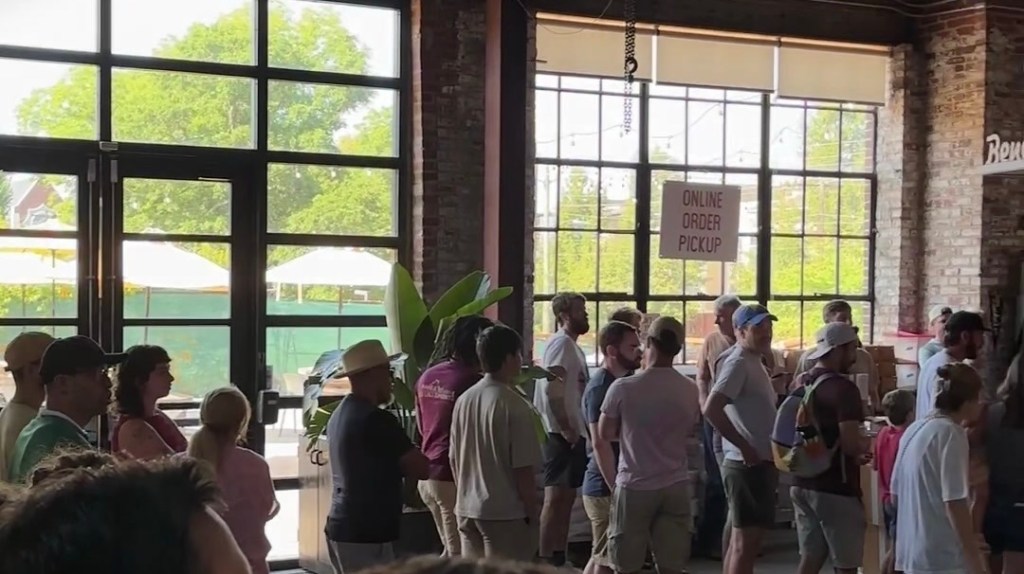
People of every age and many ethnic backgrounds are gathered together. I hear different languages and accents all around me. Children move between parents and grandparents. People stand in line, laughing and talking, waiting to get inside.
There is excitement in the air. There is warmth. There is life.
I am a pastor. For thirty-five years, Sunday mornings have ordinarily found me inside the same church building, preparing for Bible study and worship. But on this particular Sunday, I am on vacation, visiting family in Raleigh, North Carolina.
And the place filled with all this life is not a church.
It is a bagel shop.
People are gathered around tables beneath flowers and trees. They are sharing food, conversation and laughter. Friends and families are spending time together. Nobody appears to be in a hurry to leave. They are happy to be there.
After breakfast, we visit a nearby park filled with sunflowers.
There, I see much of the same thing.
People walk between long rows of flowers, taking pictures and enjoying the beauty of creation. Families gather on playgrounds and around splash pads on this hot July Sunday. The park is filled to capacity. Children are laughing. Parents are talking. People are moving freely through the sunlight.
There is something almost worshipful about it.
For someone who is normally inside a church building at this hour, it is an amazing thing to witness.
These people are together. They are enjoying one another. They are experiencing community. They are surrounded by beauty, conversation, movement and joy.
And I cannot help but compare it with the church.
They are lined up to enter the bagel shop, but they are not lined up to enter most of our churches.
Many of our churches have large rooms with plenty of empty space. We have sanctuaries, classrooms, fellowship halls, programs, committees and carefully prepared services. Yet, on many Sunday mornings, only a few people are present.
Those of us who lead churches—and those faithful people who continue to sit in the pews—keep asking the same question:
Why?
Why are people gathering in bagel shops and parks but not in our churches?
Why do they seem eager to gather everywhere except inside our buildings?
Some attend large churches, of course, although even those gatherings can sometimes feel more like carefully produced events than communities of deep relationship. But the average local church in America is struggling. We are trying to keep the doors open, the lights on and the programs running.
We are trying to survive.
And perhaps that is part of the problem.
I still believe Jesus Christ is the best gift the world has ever received. Better than bagels. Better than sunflowers. Better than anything we can build, organize or produce.
But somewhere along the way, we may have missed the point.
Since the time of Jesus, we have attached so much to him. We have built layers of institutions, customs, rules, traditions, politics and social expectations. To encounter the real Jesus, people often feel they must first dig through everything we have placed around him.
There is the political layer.
There is the cultural layer.
There is the institutional layer.
There are denominational expectations, unwritten rules and traditions whose original purposes have long been forgotten.
People may not have the time, energy or desire to work through all those layers just to discover Jesus.
I believe many people still admire him. Many are drawn to his compassion, his courage, his teachings and his love for those who were ignored or pushed aside. Many would probably love Jesus deeply if they could encounter him apart from everything the church has done to complicate his identity.
But we have damaged his reputation.
We have too often made it difficult for people to see the one who welcomed children, touched lepers, ate with outsiders and offered grace to those whom respectable society had rejected.
Meanwhile, churches spend enormous amounts of energy preserving institutions.
We worry about budgets, attendance, buildings and programs that may no longer speak to the world around us. We keep trying to repair an old vessel when perhaps we should be asking whether God is calling us to step out of it.
We are trying to keep something afloat that perhaps we need to let sink.
As Bruno Major sings, sometimes it may be time to let a good thing die.
That does not mean the church has done no good.
Churches have cared for the sick, fed the hungry, sheltered the homeless, educated children, comforted the grieving and created communities of faith that have sustained people through generations.
My own church does good things. Every Thursday, we feed around one hundred unhoused neighbors. We provide space, meals, friendship and care. I have seen the church become the hands and feet of Christ in beautiful ways.
The question is not whether the church has ever been good.
The question is whether our determination to preserve the institution is preventing us from becoming the people Jesus calls us to be.
Maybe our primary task is not to make the church attractive again.
Maybe it is to become authentic followers of Jesus.
Maybe it is not about convincing people to enter our buildings. Maybe it is about entering their lives with humility, grace and love.
Maybe we need to return to something simpler.
The bagel shop and the sunflower park looked more like Pentecost than almost anything I have seen in a long time. There were people from different backgrounds and generations gathered together. I heard many languages. There was movement, joy, life and something that felt like freedom.
I am not suggesting that eating bagels or walking among sunflowers is the same as Christian worship.
But perhaps such places reveal what people are longing for.
They are longing for community.
They are longing for beauty.
They are longing for relationships that are real.
They are longing for places where they can breathe, laugh, belong and bring their children without first having to learn the rules.
Perhaps the church began to lose its way when the structures became more important than the Spirit moving within them.
Perhaps our rules became stumbling blocks.
Perhaps we narrowed the entrance until people could no longer find their way inside.
Perhaps we became so focused on maintaining buildings, traditions and organizations that we forgot Jesus never said, “Preserve this institution.”
He said, “Follow me.”
As I watched the people at the bagel shop and walked through the sunflower park, I kept thinking about my own church on a Sunday morning.
Something feels off.
Something feels deeply off.
I do not pretend to have the answer. I am sixty-one years old and thirty-five years into this work. I have spent most of my adult life loving, serving and leading one congregation. The church is not an abstraction to me. It is my life, my calling and my community.
That is what makes these questions so painful.
Maybe it really is time to let a good thing die.
Not the church as the living body of Christ.
Not the community of people seeking to follow Jesus.
But perhaps we must let our obsession with institutional survival die.
Perhaps we must let go of the belief that success is measured by attendance, budgets, property and programs. Perhaps we must stop asking how to keep our churches alive and begin asking what it would mean for us to truly live.
What would happen if we focused less on preserving ourselves and more on becoming authentic people in the world?
What would happen if we carried Jesus beyond our walls and into bagel shops, parks, neighborhoods, shelters, playgrounds and ordinary conversations?
What would happen if people encountered Christ not first through our buildings or beliefs, but through our love?
People are still looking for something real.
They are looking for something authentic.
That is what Jesus was.
That is what drew people to him in the first place.
Maybe the future of the church does not depend upon finding a better strategy, creating another program or attracting more people to a building.
Maybe it begins with something much simpler.
Maybe we should just follow him.


Leave a comment