

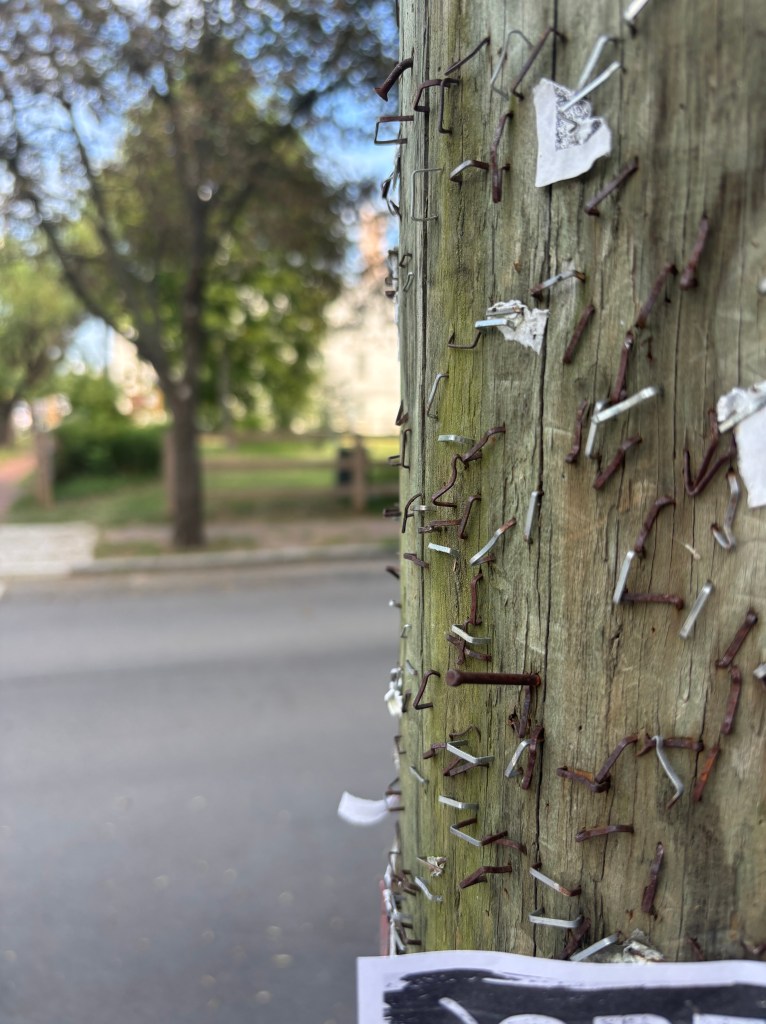
The telephone poles in our neighborhood of Oregon Hill, where our church has been a neighbor for 171 years, are littered with rusted-out staples. Thousands of them. They are the remnants of posters hung there over the years—ads for everything from missing pets, to parties, yard sales, concerts, neighborhood meetings, and sometimes events I don’t even understand.
And quite a few of those staples are mine.
For the last 35 years, I have walked the brick streets of Oregon Hill with a stack of flyers in one hand and a staple gun in the other. I’ve hung posters advertising Vacation Bible School, church events, community cookouts, craft nights, and 25 years of Community Movie Nights in Pleasants Park, right behind Pine Street Baptist Church.
I usually take pretty much the same route. I walk from pole to pole, find an open spot among all the other notices, put up the flyer, and click, click, click—drive in a few more staples.
For many years, it has been a pretty good way of getting information out. People walking down the street or getting out of their cars can stop and see what’s happening. Maybe they’ll notice that we’re showing a movie in the park Friday night. Maybe they’ll see that we’re having a cookout or something for children. Maybe they’ll decide to come.
After all, that’s one of the things churches do. We invite people.
But over 35 years, something else has happened while I’ve been walking that same route.
The neighborhood changed.
There was a time when I knew basically everybody. I could hardly make it around Oregon Hill without stopping to talk with someone. Sometimes those conversations lasted much longer than hanging the poster did. I knew people’s names. I knew their families. I knew their stories. And they knew me.
Then, slowly, that changed.
People moved away. New people moved in. The demographics of the neighborhood changed, and over time I realized that my connection with the neighborhood had changed too.
I didn’t know people like I once did.
And that troubled me.
There were times when I wondered whether I was really making much difference anymore. Not knowing the place where you minister can make you feel isolated. It can make you feel disconnected. It can even make you feel lonely.
I kept walking the same streets. I kept carrying the same staple gun. I kept putting up posters.
But something wasn’t holding anymore.
If I were a staple, I wasn’t making the connection.
That was difficult to admit. How does a church that has been in a neighborhood for generations connect with a neighborhood that has changed around it? How does a pastor who has walked these streets for decades get to know people who weren’t here before?
Eventually, I realized there really was only one thing I could do.
I had to go where they were.
So I started showing up.
I went to neighborhood events. I joined neighborhood organizations. I served on committees. I became involved in groups working to make Oregon Hill a better place. Instead of simply asking people to come to something we were doing at the church, I began going to the things they were doing.
And slowly, something happened.
People began to know me again.
Now, when I’m out walking around Oregon Hill with my posters and my staple gun, every once in a while I hear someone call my name. I stop. We talk. We laugh. We catch up.
And they’re not simply recognizing me as “the pastor over at that church.”
They’re recognizing me as a neighbor.
Sometimes even as a friend.
The staples started holding again.
Maybe that’s what ministry in a neighborhood is really about.
We spend a lot of time trying to figure out programs and strategies for reaching people. We plan events. We print flyers. We advertise. We put things on social media. And there is certainly nothing wrong with any of that.
But relationships don’t happen because somebody saw a poster.
Relationships happen because somebody showed up.
They take time. They take effort. They take energy. They take commitment. You have to keep walking the route over and over again.
Your feet get tired.
Your mind gets tired.
Sometimes your heart gets tired.
But you keep walking.
You keep showing up.
You keep listening.
You keep learning people’s names.
You keep building trust.
And sometimes, after enough time, the connection sticks.
That’s what I hope Pine Street Baptist Church has been doing in Oregon Hill all these years. I hope we’re connected to this neighborhood like one of those posters stapled to a telephone pole—not simply occupying a piece of property, but holding on, belonging here, connected to the people around us.
Because ultimately, the connection isn’t supposed to end with us.
My hope is that somehow those relationships connect people to God.
Maybe it happens through a movie in the park.
Maybe through a craft night.
Maybe through a hamburger at a community cookout.
Maybe through a party for children.
Maybe through a conversation on the sidewalk.
Maybe simply because someone realizes that a church noticed them, remembered their name, showed up, and cared.
And maybe somewhere in that connection they begin to discover something much greater:
God loves them.
There must be thousands of staples in the telephone poles of Oregon Hill from posters I’ve hung during these last 35 years. Most are rusted now. Many aren’t holding anything anymore. Nobody remembers the posters they once held.
But I think I’ll keep walking those brick streets with my staple gun.
I’ll keep putting up the flyers.
I’ll keep showing up.
I’ll keep trying to make connections.
Because after 35 years, I’ve learned something about staples and ministry:
Not every staple is going to hold forever.
But if just one sticks—if one invitation becomes a conversation, if one conversation becomes a friendship, if one friendship helps somebody discover that they are known and loved by God—
then every step around that neighborhood,
every poster I’ve carried,
and every staple I’ve driven into those old telephone poles has been worth it.


Leave a Reply