

I’m sitting beneath an umbrella, surrounded by trees, bushes, and potted flowers. The patio furniture is comfortable, and the sunshine is warm. It ought to be relaxing. But traffic keeps passing nearby, and I find it hard to settle.
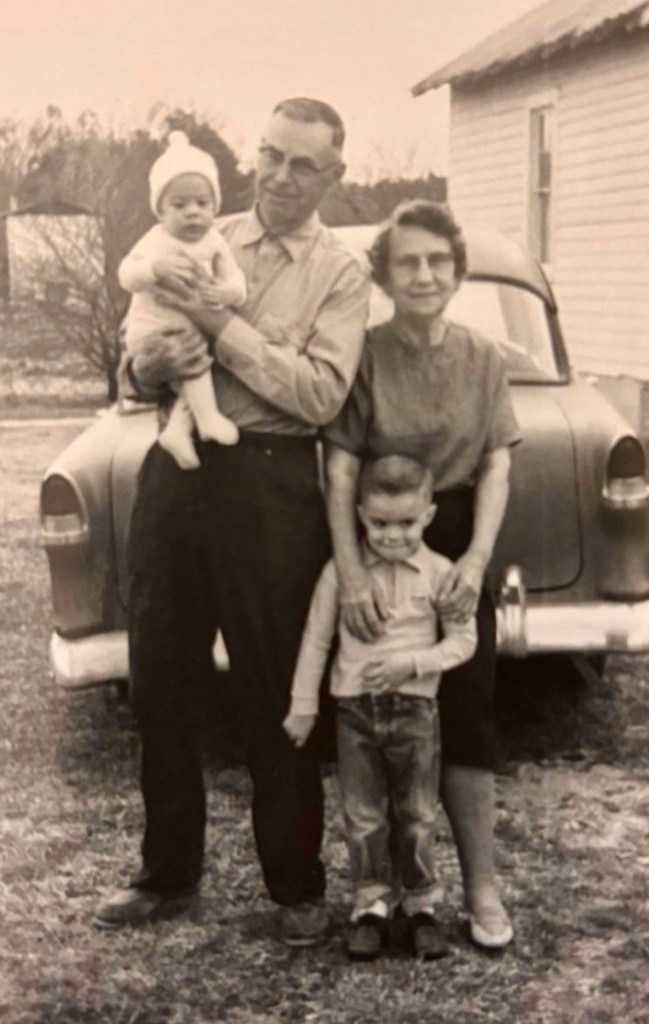
My mind drifts to my grandparents’ farm in rural North Carolina. I spent so much of my childhood there, in every season, though summer seemed to stretch on forever. Two long dirt driveways led to their house. Cars raised clouds of dust on the way in. By today’s standards, it wasn’t much of a house, but to us it was home. Those driveways felt almost like church aisles, welcoming us into a sacred place.
Once we arrived, our shoes came off, often our shirts too, and we were free to roam. My siblings, cousins, and I climbed trees, crossed fields, explored barns and woods, and played until someone called us back. We returned dusty, scratched, and happy.
My grandfather grew apples, pears, cherries, and plums. There were blackberries to pick, honeysuckle to taste, and grapes on the vine. We chased squirrels, watched birds, listened to chickens, and played with the piglets. In the plowed fields, we looked for arrowheads, reminders that people had walked that land long before us.
“The earth is the LORD’s, and the fulness thereof.” — Psalm 24:1
I didn’t think about that verse while I was climbing a fence or reaching for an apple. I didn’t know to call the farm holy ground. I only knew that I belonged there, with my family, under those trees and beneath that wide sky. Looking back, I can see how deeply those days shaped me.
Psalm 24:1 gives language to what I sensed as a child. The farm did not belong to us simply because my grandparents lived there or worked the soil. It belonged first to God—the land, the trees, the animals, the fields, and every living thing that moved across them. My grandparents were caretakers, and we were guests, even when we felt completely at home. The dusty driveways were not merely paths leading to a house; they led into a portion of God’s creation entrusted to our family for a time.
That understanding makes the memories feel larger than nostalgia. The apples we picked, the grapes we tasted, and the arrowheads we found were gifts within a world we had not made. The freedom we enjoyed was not separate from God’s goodness; it was one of the ways we encountered it. We learned, without realizing it, that creation could welcome us, nourish us, surprise us, and remind us that life was more abundant than our small concerns.
Now there are schedules to keep, bills to pay, and responsibilities that follow me even when I sit down to rest. Sometimes I long to go up those dusty driveways again, take off my shoes, and spend an afternoon with no purpose beyond exploring. I would give a great deal to find another arrowhead in the dirt, climb one more tree, and feel my grandmother’s hug and my grandfather’s embrace.
I can’t return to that childhood. I can’t make the farm exactly as it was, and I can’t recover the years that have passed. Yet Psalm 24:1 reminds me that God’s ownership and goodness were never limited to that particular place or season. The farm revealed something true about the whole world: wherever I am, I am still surrounded by what belongs to God. The same Lord who filled those fields with fruit and birds has not withdrawn His gifts simply because I have grown older or moved farther away.
The traffic may be loud, but the sunshine is real. The flowers beside me are real. The trees, bushes, and potted plants are not insignificant decorations; they are present reminders that creation is still offering itself to my attention. If the earth is the Lord’s and its fullness belongs to Him, then this small patio is not outside His care. It may not feel like my grandparents’ farm, but it can still become a place where I recognize His generosity.
Perhaps noticing God’s goodness now begins in the same way it did then: by slowing down enough to look. I can listen beyond the traffic for the movement of leaves. I can feel the warmth of the sun on my skin. I can study the colors of the flowers and receive the moment without demanding that it become something else. I can remember the freedom of the farm without treating the present as empty by comparison. The memory can teach me how to see, rather than only remind me of what I have lost.
The dusty driveways led me into a world I did not own but was invited to enjoy. Today, gratitude can lead me into this moment in much the same way. I am still a guest in God’s world, still surrounded by His gifts, still capable of receiving them. The goodness I knew beneath those wide skies has not disappeared; it is present here, waiting to be noticed.
May we not miss the goodness of God’s earth, even here.


Leave a Reply